

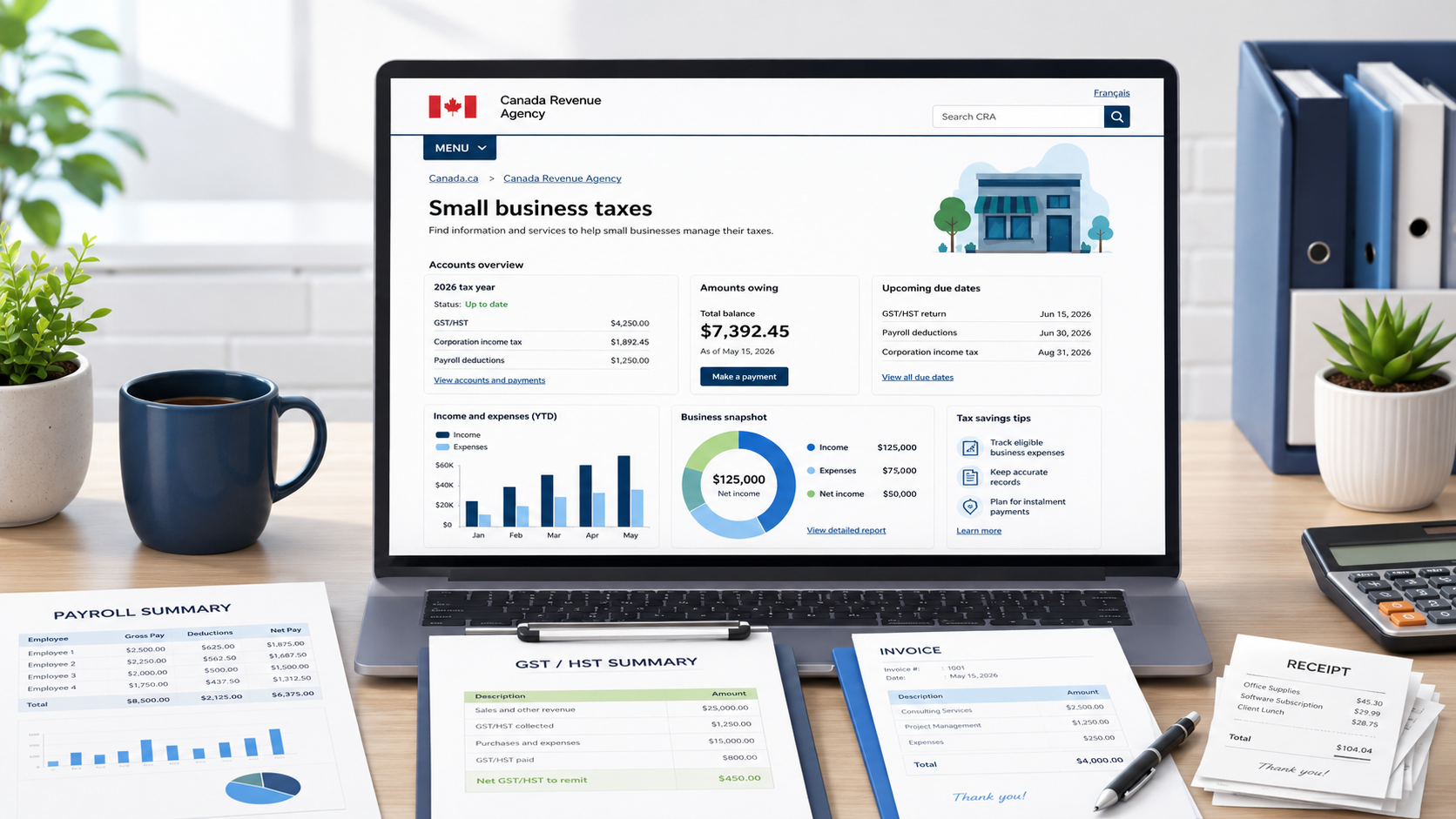
2026 Tax Changes Canadian Small Businesses Should Not Ignore
For Canadian small businesses, 2026 is not just another tax year. It is a year where payroll setup, GST/HST filing discipline, CRA digital access, business rebates, tax credits, and long-term exit planning all deserve closer attention.
The big lesson is simple: businesses with clean books, organized payroll records, and reliable financial reporting will be in a much better position than businesses still relying on spreadsheets, disconnected apps, or last-minute bookkeeping.
This article is not tax advice. Business owners should confirm decisions with an accountant or tax professional. But from an operations perspective, these are the 2026 tax items small businesses should have on their radar.
Payroll Deductions Need a 2026 Reset
Payroll is one of the most important areas to review in 2026 because contribution limits and maximums have changed.
For 2026, the CPP maximum annual pensionable earnings are $74,600, the basic exemption remains $3,500, the employee and employer contribution rate is 5.95%, and the maximum annual employee and employer CPP contribution is $4,230.45 each. CRA also notes that CPP2 deductions apply on earnings above the annual maximum pensionable earnings. (Canada)
EI also changes in 2026. The federal maximum annual insurable earnings are $68,900, the federal EI rate is 1.63%, the maximum annual employee premium is $1,123.07, and the maximum annual employer premium is $1,572.30. Quebec has a separate EI rate and maximums. (Canada)
For small businesses, this means payroll cannot be treated as a "set it and forget it" process. If payroll settings are not updated properly, the business may under-deduct, over-deduct, or create year-end cleanup work for employees, owners, and bookkeepers.
Awditify helps by giving businesses a more organized way to manage payroll-related financial data, reporting, and recordkeeping so teams are not scrambling to reconcile payroll numbers after the fact.
Self-Employed Owners Still Need to Watch Two Deadlines
A common mistake among self-employed business owners is assuming that the filing deadline and payment deadline are the same.
For the 2026 filing season, CRA states that most individuals must file their 2025 return and pay amounts owing by April 30, 2026. Self-employed individuals have until June 15, 2026, to file, but any tax owing is still due by April 30, 2026, to avoid interest. (Canada)
That matters for sole proprietors, consultants, contractors, freelancers, and owner-operated businesses. A later filing deadline does not mean a later payment deadline.
The practical takeaway: business owners should know their expected tax position before April, not after. Clean monthly books make that possible. Waiting until tax season to understand profit, expenses, and cash flow creates unnecessary risk.
GST/HST Filing Depends on Your Reporting Period
GST/HST is another area where small businesses often get caught by timing issues.
CRA states that monthly and quarterly GST/HST filers generally have a filing and payment deadline one month after the end of the reporting period. Annual filers with a December 31 fiscal year-end and business income have a final payment deadline of April 30 and a filing deadline of June 15. Businesses with a non-December fiscal year-end generally have a filing and payment deadline three months after fiscal year-end. (Canada)
This is why GST/HST should not be managed from memory. Businesses need reliable tracking of sales tax collected, input tax credits, filing periods, payments, and supporting documentation.
Awditify supports stronger financial visibility by helping business owners and finance teams keep transaction data, reports, and records organized throughout the year instead of rebuilding the story at filing time.
The Canada Carbon Rebate for Small Businesses Is Now Non-Taxable
One important 2026 update for eligible incorporated businesses is the tax treatment of the Canada Carbon Rebate for Small Businesses.
CRA says legislation passed on March 26, 2026 makes the Canada Carbon Rebate for Small Businesses non-taxable for all fuel charge years. The rebate was designed to return a portion of federal fuel charge proceeds from 2019-2020 through 2024-2025 to eligible Canadian-controlled private corporations. CRA also says eligible businesses do not need to apply because payments are issued automatically. (Canada)
This is especially relevant for small incorporated businesses that received or expect rebate amounts. The accounting treatment matters because a rebate that was previously included in income may need review depending on the year and circumstances.
This is exactly the kind of detail that shows why accurate bookkeeping matters. If rebates, credits, deposits, and adjustments are not properly categorized, owners may not have a clear view of true income, tax exposure, or cash flow.
SR&ED Planning Got More Useful for Innovative Businesses
Not every small business claims SR&ED, but for technology companies, manufacturers, product developers, and other innovation-driven businesses, 2026 introduced a useful planning option.
CRA's optional SR&ED pre-claim approval process allows eligible businesses to have planned work evaluated before incurring significant costs. CRA states that eligible businesses must be a Canadian-controlled private corporation, another Canadian corporation, or a partnership, have gross business income under $25 million, and be in good standing with CRA. (Canada)
This matters because SR&ED claims depend heavily on documentation. Businesses need to track project work, costs, payroll, contractor expenses, technical uncertainty, and supporting records. Weak records can turn a good claim into a stressful claim.
Awditify can support this kind of financial discipline by helping businesses maintain better organized records, expense visibility, and reporting workflows.
Capital Gains and Exit Planning Need Extra Attention
For owners thinking about selling a business, reorganizing shares, or planning succession, capital gains rules should be reviewed carefully in 2026.
CRA notes that the government proposed increasing the lifetime capital gains exemption from $1,016,836 to $1,250,000 for dispositions after June 24, 2024, with annual indexation resuming in 2026. CRA also states that it reverted to administering the currently enacted one-half capital gains inclusion rate, and that gains realized before January 1, 2026 are subject to the one-half inclusion rate unless an exemption applies. (Canada)
For small business owners, this is not just a tax technicality. It can affect retirement planning, business sale timing, shareholder planning, and the value of proper corporate records.
Owners should work with a qualified tax advisor before making decisions, but the finance-system lesson is clear: clean historical records, accurate equity tracking, and reliable financial statements make planning easier.
The Bigger 2026 Tax Lesson: Better Systems Reduce Risk
The most important 2026 tax issue for small businesses is not one single deadline. It is the rising cost of poor financial organization.
When payroll, bookkeeping, receipts, GST/HST, expenses, reports, and CRA-related records are scattered across spreadsheets, inboxes, bank downloads, and manual folders, business owners lose visibility. They also create more work for bookkeepers, accountants, and internal teams.
Awditify gives small businesses a modern way to manage accounting, bookkeeping, payroll-related financial workflows, reporting, and business records in one more organized cloud-based system.
Instead of waiting until tax season to find missing information, businesses can build cleaner habits all year.
Final Thoughts
Small businesses that want a smoother 2026 tax year should focus on three things: accurate payroll setup, timely GST/HST and tax planning, and better financial recordkeeping.
Tax rules may change, but one thing does not: messy books make compliance harder.
Awditify helps small businesses move away from disconnected manual workflows and toward clearer financial visibility, better reporting, and a more organized way to manage business finance.
Ready to make 2026 easier to manage? Explore Awditify or book a demo to see how modern cloud-based financial management can help your business stay organized, informed, and ready for growth.



Discussion
Comments